 by Jermaine
Understanding the mistakes to avoid when buying land in Antigua
Buying land in Antigua can be an excellent opportunity to build a dream home, invest in Antigua Property or secure property for future development. With its beautiful beaches, tropical climate, and attractive lifestyle, Antigua appeals to both local and international buyers. However, purchasing land requires careful research, legal verification, and financial planning.
A plot that looks perfect during a viewing may have unclear ownership, planning restrictions, limited road access, or expensive development requirements. These issues can turn an attractive investment into a costly mistake, particularly for foreign buyers unfamiliar with local property regulations.
Understanding the mistakes to avoid when buying land in Antigua can help you protect your investment and make an informed decision. Whether you are buying residential land, a coastal plot, or property for commercial development, the following guide covers the essential checks to complete before signing an agreement.
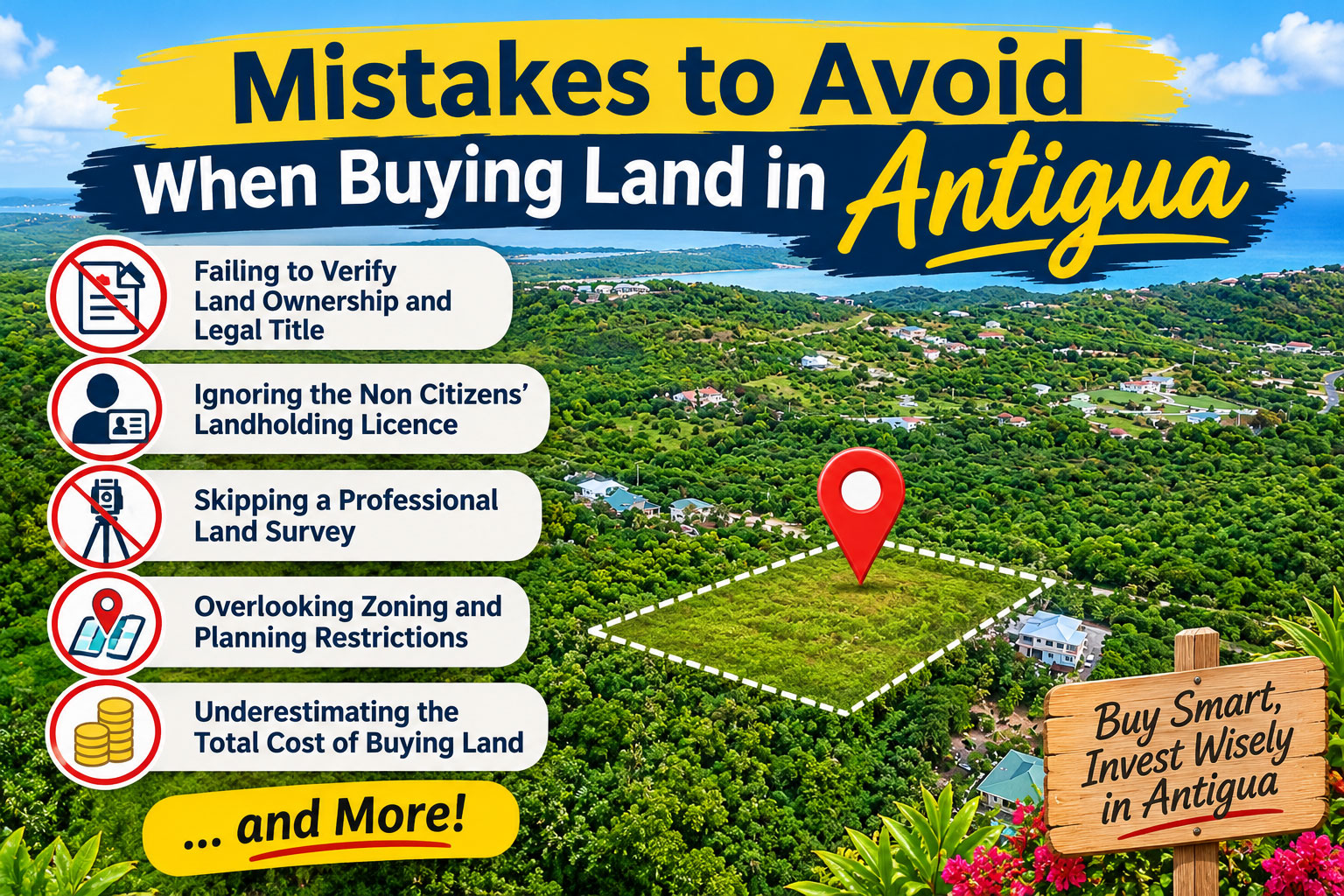
Failing to Verify Land Ownership and Legal Title
One of the biggest mistakes when buying land in Antigua is assuming that the seller has the legal right to sell the property. An attractive listing, survey plan, or verbal promise does not guarantee clear ownership.
Before proceeding, appoint an independent local attorney to investigate the property’s title and verify the seller’s authority to transfer ownership. The investigation should identify any relevant mortgages, registered charges, easements, ownership disputes, or restrictions that could affect the transaction.
If the land belongs to an estate, company, or multiple owners, additional documents may be required to establish who can legally complete the sale.
Tip: Never rely solely on documents supplied by the seller. Have your attorney independently verify the property’s legal status before committing substantial funds.
Check Why More Buyers Are Looking for Land in Antigua in 2026
Ignoring the Non Citizens’ Landholding Licence
Foreign buyers should understand the rules governing non-citizen ownership before purchasing land in Antigua. Depending on their circumstances, non-citizens may need a Non Citizens’ Landholding Licence to acquire property.
Do not assume that using a locally incorporated company automatically removes licensing requirements. The rules may depend on the ownership structure and the nature of the transaction.
Before signing a binding agreement, consult a qualified local attorney about the applicable licence, government fees, application documents, and expected processing time. You should also establish what happens to your deposit if approval is delayed or refused.
Tip: Confirm the licensing requirements early so that your purchase agreement and completion schedule account for any necessary approvals.
Skipping a Professional Land Survey
A property’s boundaries may not be as obvious as they appear. Fences, vegetation, neighbouring structures, and informal access paths can create confusion about the actual size and position of the land.
A professional survey helps verify boundaries, dimensions, and the property’s relationship to the legal description. It may also reveal encroachments, boundary discrepancies, or access issues.
This is particularly important when buying undeveloped, coastal, or hillside land. An older survey plan may not be sufficient, so ask your attorney and surveyor whether updated measurements or boundary verification are necessary.
Tip: Arrange an independent survey before completing the purchase, especially if the plot’s size, shape, or access affects your building plans.
Overlooking Zoning and Planning Restrictions
Not every plot in Antigua can be used for every purpose. Land suitable for a private home may not automatically be suitable for apartments, a guesthouse, a commercial building, or a larger tourism development.
Before buying, check the property’s zoning, permitted uses, building setbacks, subdivision possibilities, and relevant planning conditions with the appropriate authority, including the Development Control Authority where applicable.
Never rely exclusively on a seller’s assurance that the land is suitable for construction. If you intend to build several rental units, for example, planning restrictions could affect the number of units permitted or whether the project can proceed.
Tip: Verify that your intended use is permitted before purchasing land for a specific development project.
Underestimating the Total Cost of Buying Land
The advertised price is only one part of the total cost of buying land in Antigua. Additional expenses may include legal fees, applicable taxes and duties, licence fees, surveys, valuations, and registration-related costs.
Undeveloped land may also require clearing, grading, drainage work, road improvements, utility connections, and engineering assessments before construction can begin.
| Potential expense | What to consider |
| Legal fees | Title checks and conveyancing |
| Applicable taxes and duties | Current rates and payment responsibilities |
| Licence fees | Requirements for non-citizen buyers |
| Survey and valuation | Boundaries and property value |
| Site preparation | Clearing, grading, and drainage |
| Utilities | Water, electricity, and telecommunications |
| Ongoing ownership costs | Property-related taxes and maintenance |
Foreign buyers should also investigate whether non-citizen undeveloped land tax applies to their property.
Tip: Request an itemised cost estimate and maintain a contingency budget for unexpected expenses.
Read on Land for Sale in Antigua: What Can US$100,000, US$250,000 and US$500,000 Buy?
Choosing Land Based Only on Price
A low asking price can be tempting, but cheap land is not always a good investment. The property may be inexpensive because it has poor access, steep terrain, limited utilities, planning restrictions, or substantial site preparation requirements.
Compare properties based on location, usable area, infrastructure, legal status, development potential, and comparable sales where reliable data is available.
For example, a plot with road access and nearby utilities may cost more initially but require less investment before construction. A cheaper, remote property could ultimately cost more once infrastructure and preparation expenses are included.
Tip: Compare the total estimated cost of ownership and development rather than focusing only on the purchase price.
Ignoring Road Access and Utilities
Before buying land, confirm whether it has legal access to a public road or a properly established right of way. An informal track across neighbouring property may not provide permanent legal access.
You should also check the availability and cost of connecting electricity, water, telecommunications, and appropriate wastewater facilities. Nearby utility infrastructure does not guarantee that a connection will be straightforward or inexpensive.
Poor access and limited utilities can delay construction and affect the property’s future resale value.
Tip: Verify access rights and obtain realistic utility connection estimates before completing the transaction.
Overlooking Drainage, Flooding, and Coastal Risks
Antigua’s tropical climate and coastal environment make site conditions an important part of property due diligence. Heavy rainfall, poor drainage, erosion, and storm exposure can affect land suitability and future construction costs.
Low-lying plots may experience water accumulation, while steep sites may require drainage systems or retaining walls. Coastal properties may face additional challenges associated with salt exposure, wind, shoreline changes, and applicable development restrictions.
If necessary, consult qualified engineers about drainage, soil conditions, flood exposure, and the suitability of the site for your intended building.
Tip: Inspect the land carefully and investigate environmental and engineering risks before purchasing, particularly for coastal or hillside properties.
Buying Without Independent Legal Advice
An Antigua real estate agent can help you find properties and negotiate a price, but an independent attorney provides essential legal protection during the transaction.
Your attorney should review the title, investigate the seller’s authority, explain the purchase agreement, identify relevant licensing requirements, and guide you through the transfer process.
This is especially important if you live overseas and cannot easily attend meetings or verify documents in person. Ask about the legal fees, services included, and any additional checks your purchase may require.
Tip: Appoint your own qualified local attorney rather than relying entirely on the seller’s assurances or the agent’s explanations.
Rushing into a Deposit or Purchase Agreement
Buyers sometimes feel pressured to pay immediately because a seller claims there are competing offers. However, rushing into a transaction before completing essential checks can expose you to unnecessary financial risks.
Before paying a deposit, ensure that your attorney has reviewed the purchase agreement. Understand the payment terms, completion date, required approvals, and circumstances in which your deposit may or may not be refundable.
Verify payment instructions independently, especially when transferring funds internationally. Do not rely on an unexpected email requesting new bank details without confirming the change through a trusted channel.
Tip: Establish appropriate contractual protections and verify the recipient’s details before transferring substantial funds.
Failing to Research the Neighbourhood
The surrounding area can significantly influence your lifestyle, development plans, and investment returns. Before buying, assess road conditions, nearby shops, healthcare facilities, transport, noise levels, and access to essential services.
If you are purchasing land for a holiday rental, consider whether the location suits your intended visitors. If you are planning a permanent home, prioritise everyday convenience and accessibility.
Investigate possible future developments nearby as well. New infrastructure can improve property appeal, but construction may also affect privacy, views, traffic, or noise.
Tip: Visit the area at different times when possible and research relevant development proposals before committing.
Assuming Every Plot Is Suitable for Construction
A plot may have a clear legal title and residential zoning but still present physical challenges that make construction expensive.
Steep slopes, difficult soil conditions, drainage problems, and limited building space can increase foundation and site preparation costs. A property that appears spacious may offer less usable land than expected.
If construction is your goal, consult a surveyor, engineer, or architect before purchasing. Depending on the site, you may need a topographic survey, geotechnical assessment, drainage evaluation, or preliminary building plan.
Tip: Establish whether the land is physically suitable for your intended project and obtain an initial development cost estimate.
Explore on Buying Land vs Buying a House in Antigua
Ignoring Property Taxes and Ongoing Ownership Costs
Land ownership comes with responsibilities beyond the initial purchase. Depending on the property and your circumstances, you may have applicable property taxes, non-citizen undeveloped land tax, maintenance costs, and other ongoing expenses.
Foreign buyers should verify their tax obligations directly with the relevant authorities or a local tax professional. Tax rates, exemptions, and administrative requirements can change, so avoid relying on outdated online figures.
Also consider the cost of clearing vegetation, maintaining access roads, securing the site, and managing any existing structures. If you own through a company, additional accounting and compliance costs may apply.
Tip: Prepare an annual ownership budget before buying so that ongoing expenses do not become an unexpected financial burden.
Assuming Land Prices Will Always Increase
Land can appreciate over time, but price growth is never guaranteed. Resale value depends on location, market demand, infrastructure, legal status, planning potential, and broader economic conditions.
Before investing, research comparable properties and consider who might buy the land from you in the future. A plot with limited access or expensive development requirements may be harder to sell, even if its original price was attractive.
Avoid making a purchase based solely on promises that an area will become a major tourism destination or that future infrastructure will automatically increase property values.
Tip: Assess the property’s current value, realistic resale prospects, and your ability to hold it for the long term.
Confusing Antigua and Barbuda Property Rules
Although Antigua and Barbuda form one sovereign country, buyers should not assume that every property transaction follows identical procedures on both islands.
Barbuda has a distinct land history and legal framework. Buyers considering property there should verify the title, seller’s authority, applicable ownership arrangements, and registration process for the specific parcel.
Do not assume that documentation or practices associated with purchasing land in Antigua automatically apply in Barbuda.
Tip: Consult a local attorney familiar with the relevant island and property type before entering into a transaction.
A Practical Checklist Before Buying Land in Antigua
Use this checklist to help you organise your due diligence before completing a purchase:
- Verify the seller’s identity and legal authority to sell.
- Conduct an independent title search.
- Confirm boundaries through a professional survey.
- Check whether a Non Citizens’ Landholding Licence is required.
- Investigate mortgages, easements, and restrictions.
- Confirm zoning and planning requirements.
- Verify legal road access and utility availability.
- Assess drainage, terrain, and environmental risks.
- Obtain estimates for purchase and development costs.
- Check applicable taxes and ongoing ownership expenses.
- Have an independent attorney review the agreement.
- Confirm deposit protections and secure payment arrangements.
Keep copies of contracts, reports, receipts, and official correspondence. Organised records make it easier to resolve questions and help ensure that important checks are not overlooked.
Read on Why Americans Are Buying Real Estate in Antigua: The Caribbean Property Trend Growing in 2026
Conclusion
Buying land in Antigua can be a valuable step toward owning a Caribbean home or building a real estate investment. However, a successful purchase requires more than finding an attractive plot at a good price.
The most important mistakes to avoid include failing to verify ownership, overlooking foreign ownership requirements, ignoring planning restrictions, underestimating costs, and rushing into a deposit or purchase agreement.
Take time to investigate the legal title, confirm access and utilities, assess environmental conditions, and understand the land’s development potential. Work with an independent attorney and qualified professionals who can evaluate the property before you commit your money.
With careful research and realistic financial planning, you can reduce avoidable risks and make a more informed decision when buying land in Antigua.
Browse land for sale in Antigua” and “contact JMVI Realty
Frequently Asked Questions
Can foreigners buy land in Antigua?
Yes, foreign nationals can generally purchase land in Antigua, subject to applicable laws and licensing requirements. Non-citizen buyers should consult a local attorney to establish whether a Non Citizens’ Landholding Licence is necessary.
What is the biggest mistake when buying land in Antigua?
Failing to verify the legal title is one of the most serious mistakes. An independent title search helps identify ownership issues, registered interests, and restrictions that could affect the purchase.
Do I need a lawyer to buy land in Antigua?
Independent legal advice is strongly recommended. A local attorney can investigate ownership, review the contract, explain licensing requirements, and guide you through the transfer process.
What additional costs should I expect?
Depending on the transaction, you may need to budget for legal fees, applicable taxes and duties, licence fees, surveys, site preparation, utility connections, and ongoing property-related expenses.
How do I check whether land is suitable for building?
Confirm zoning and planning requirements with the appropriate authority, then consult a qualified surveyor or engineer if needed. Assess boundaries, access, terrain, drainage, soil conditions, and estimated construction preparation costs.